

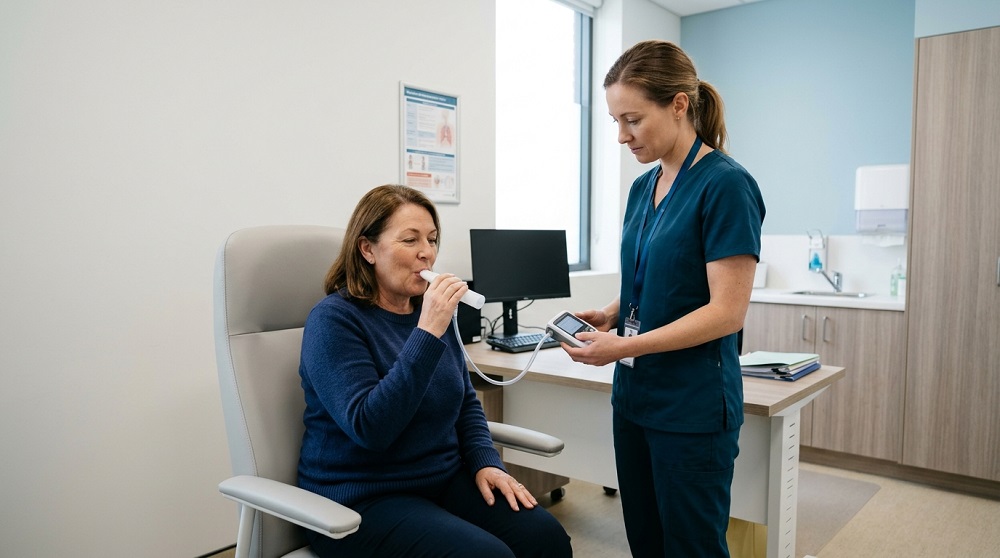
Understanding what happens during the test can make the process feel more straightforward. Here is what you need to know about spirometry, why it may be recommended and how to prepare for your appointment.
What Is a Spirometry Test?
A spirometry test is a breathing assessment performed using a device called a spirometer. You take a deep breath and then blow into a mouthpiece as firmly and completely as possible. The device records how much air you exhale and how quickly the air leaves your lungs.
Unlike a blood test, spirometry does not require a needle or a blood sample. Instead, it measures your breathing performance to help your GP assess whether air is moving through your airways as expected.
The test is often used when symptoms suggest a possible breathing problem. It can also help doctors monitor an existing lung condition and assess whether treatment is making a difference.
Why Might You Need a Spirometry Test?
Your GP may recommend spirometry if you have symptoms that could be related to your lungs or airways. These symptoms can have several possible causes, so testing may help provide a clearer picture before treatment decisions are made.
Common reasons for having a spirometry test include:
- Persistent cough: Investigating a cough that continues for several weeks, particularly when other respiratory symptoms are present.
- Shortness of breath: Assessing breathing difficulties during everyday activities or physical exertion.
- Wheezing: Investigating a whistling sound when breathing, which may be associated with narrowed airways.
- Suspected asthma: Measuring airflow and, when appropriate, assessing how breathing changes after using a prescribed reliever medication.
- Possible COPD: Helping identify persistent airflow obstruction in people who may have chronic obstructive pulmonary disease.
- Monitoring treatment: Checking lung function over time to help your doctor assess whether your current management plan is working.
Your GP will review your symptoms, medical history, smoking history if relevant, and other clinical findings to determine whether spirometry is suitable for you.
What Does a Spirometry Test Measure?
Spirometry measures several aspects of lung function, including two key values: forced expiratory volume in one second (FEV1) and forced vital capacity (FVC).
Forced Expiratory Volume in One Second (FEV1)
FEV1 measures how much air you can forcefully exhale in the first second of the test. A lower-than-expected reading may suggest restricted airflow from the lungs, but your GP will assess the result alongside your symptoms and medical history.
Forced Vital Capacity (FVC)
FVC measures the total volume of air you can forcefully breathe out after taking your deepest possible breath. Your GP assesses this measurement alongside FEV1 to gain a clearer understanding of your lung function.
The FEV1/FVC ratio compares these two measurements and can help identify signs of restricted airflow. However, spirometry alone cannot detect every lung condition. If the results are inconclusive or do not fully explain your symptoms, your GP may recommend further tests or assessment.
What Happens During a Spirometry Test?
A spirometry appointment is generally straightforward and does not involve needles. Your healthcare professional will explain the procedure and guide you through each step.
- Initial assessment: Your GP or healthcare professional reviews your symptoms, medical history and any relevant medications.
- Positioning: You will usually sit upright and may be asked to wear a nose clip to prevent air escaping through your nose.
- Taking a deep breath: You fill your lungs as fully as possible before placing your lips firmly around the mouthpiece.
- Breathing out: You blow out as hard, fast and long as instructed so the spirometer can record your airflow and the amount of air exhaled.
- Repeating the test: The manoeuvre is usually repeated several times to obtain reliable measurements.
In some cases, your GP may arrange reversibility testing. This involves repeating spirometry after you have used a prescribed bronchodilator inhaler and waited for the recommended period.
Comparing the results shows whether the medication has improved airflow through your lungs.
You may feel slightly light-headed after taking forceful breaths during the test. If you feel dizzy or uncomfortable at any point, let the healthcare professional know.
How Should You Prepare for a Spirometry Test?
Following the preparation instructions provided by your clinic can help produce more reliable results. Your GP may recommend that you:
- Wear comfortable clothing that does not restrict your chest or breathing.
- Avoid a large meal shortly before your appointment.
- Avoid smoking and strenuous exercise beforehand, according to your clinic’s instructions.
- Bring an up-to-date list of your medications and inhalers.
- Tell your GP if you have recently been unwell or have a chest infection.
Some inhalers may need to be withheld for a specific period before testing, depending on the type of assessment being performed. However, never stop or change your medication unless your GP or healthcare professional specifically instructs you to do so. Always follow the advice provided for your individual circumstances.
How Are Spirometry Results Interpreted?
Your spirometry results are compared with expected values based on relevant factors, including your age, height and sex. Your GP will assess the measurements alongside your symptoms and medical history rather than relying on a single number.
Results that show reduced airflow may support a diagnosis of an obstructive lung condition, such as asthma or COPD. Other patterns may indicate that additional investigations are needed.
A normal result does not always rule out asthma. Asthma symptoms and airflow limitation can vary over time, which means the test may be normal when symptoms are not active. Depending on your situation, your GP may recommend repeating the test or arranging other investigations.
Your doctor will explain what the findings mean for you and discuss any recommended follow-up, treatment adjustments or further testing.
Can a Spirometry Test Diagnose Asthma or COPD?
Spirometry plays an important role in assessing both asthma and COPD, but the results need to be considered as part of a broader clinical assessment.
For suspected asthma, spirometry may help identify variable airflow limitation, particularly when measurements are compared before and after a bronchodilator. For suspected COPD, persistent airflow obstruction can support the diagnosis when considered alongside symptoms and relevant risk factors.
Neither condition should be diagnosed or excluded using symptoms or a single test result alone. Your GP will determine whether further testing or specialist assessment is necessary.
Spirometry at Toongabbie Doctors
If you are experiencing ongoing cough, wheezing or unexplained breathlessness, speaking with a GP is a sensible first step. At Toongabbie Doctors, spirometry is available to help assess lung function, investigate respiratory symptoms and monitor conditions such as asthma and COPD when clinically indicated.
The practice offers spirometry as part of its medical services, with testing and interpretation covered by bulk billing for eligible patients with a valid Medicare card when the test is clinically indicated. Your GP can explain whether the test is appropriate for you and what follow-up may be needed.
Learn more about the clinic’s spirometry service or explore the full range of medical services at Toongabbie Doctors.
To discuss your symptoms or arrange an appointment, call (02) 7813 6000 or book through the practice’s online booking options.
Is a spirometry test painful?
No. Spirometry is a non-invasive test and does not involve needles. Blowing out forcefully several times may feel tiring, and some people experience brief light-headedness.
How long does a spirometry test take?
The breathing manoeuvres themselves are usually brief, but the total appointment time depends on your assessment. If reversibility testing is required, allow additional time as directed by your clinic.
Can a spirometry test detect asthma?
Spirometry can help identify airflow changes associated with asthma. However, results can be normal between episodes, so your GP may recommend additional testing if asthma is still suspected.
Do I need a referral for spirometry?
Contact Toongabbie Doctors to discuss your symptoms, appointment options and whether spirometry is suitable for your circumstances.
Take the Next Step for Your Respiratory Health
Understanding what a spirometry test measures can help you feel more prepared if your GP recommends one. The test provides useful information about airflow and lung function, helping guide decisions about further investigations and respiratory care.
If breathing symptoms are affecting your daily life, book an appointment with Toongabbie Doctors to discuss your concerns and determine the most appropriate next step.